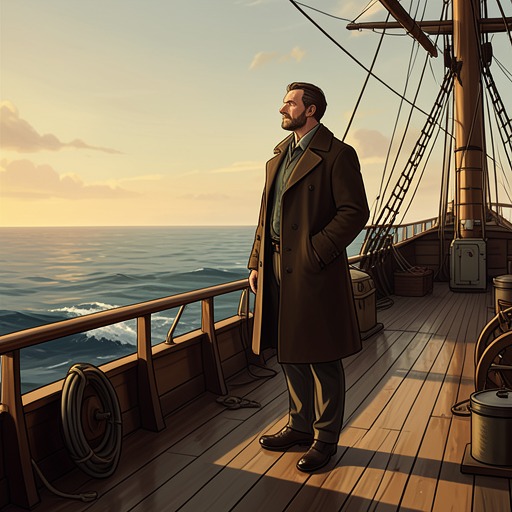
North-West Passage
The WhaleThe North-West Passage is the sought-after northern route connecting the Atlantic and Pacific, a place where the search for access through Arctic ice becomes entangled with the history of whaling and the limits of human knowledge. In the account, it is first a goal pursued by explorers and a possibility inferred from a whale’s body; later, as polar ice recedes, it becomes an emerging passage and a renewed opening for resource exploitation.
An Arctic Quest
William Scoresby Sr. pursued the North-West Passage in the hope of sailing beyond the eighty-ninth parallel, where a £1,000 prize awaited a successful navigator. The search also promised access to the whales’ remote grounds. In 1803 he took command of the Resolution, a double-hulled ship with metal plating on its bow to push through Arctic ice. His son, William Scoresby Jr., sailed with him at fourteen, entering a family history of Arctic whaling, exploration, and invention.
Scoresby Sr.’s equipment reflected the hazards and ambitions of the journey. Among his inventions was an enclosed crow’s nest, protected by a leather or canvas framework and fitted with storage for a telescope and firearm, as well as flags and a speaking trumpet for communication. The North-West Passage thus appears not as an abstract line on a map but as a difficult route that shaped ships, instruments, and the work of those trying to find it.
A Clue Carried by a Whale
In 1813, a stone lance was found embedded in the blubber of a whale killed near Spitsbergen. The wound had healed, leaving only a small white scar. Scoresby reasoned that the tool had been made by people living on the still-unexplored northern coast of the American continent. If a whale caught in the Atlantic carried an implement originating on the Pacific side, then, he inferred, a passage must connect the two oceans. The animal became evidence of movement across a geography that human explorers had not yet traversed.
The inference belonged to a longer history of speculation. Three centuries earlier, Sir Humphrey Gilbert had used a narwhal horn found on the Tartary coast as evidence in an argument for a northern passage. For Scoresby and his father, the stone lance offered a more startling clue: their search for a navigable route was joined to a question about how far whales travelled and how old they might be.
From Observation to Literary Imagination
Scoresby’s account recorded the discovery with measured amazement, but Herman Melville enlarged its implications. After borrowing Scoresby’s Arctic book in 1850, Melville adapted the stone-lance story in Moby-Dick: Ishmael reports a stone point found in a whale whose flesh had healed around it, and wonders whether it might have been thrown long before the discovery of America. The passage’s exploration history thereby enters a literary meditation on the whale’s age and the limits of human certainty.
The movement from physical trace to conjecture is central to the passage’s meaning. The lance is not a map, and the whale’s route cannot be reconstructed from it with certainty; it is a durable object that makes an unseen connection imaginable. Scoresby read it as evidence for a way through the north, while Melville used it to suggest a past that exceeds recorded human history.
An Opening Recast as a Threat
The North-West Passage changes significance as the climate changes. The account describes polar citadels receding and the route becoming a permanent reality as fresh water locked in polar ice enters the ocean. A passage once sought through the dangers of ice is thus opened by environmental loss, while northern nations prepare to exploit Arctic resources anew.
That opening carries uncertain consequences for whales and their food supply. Krill dependent on algae beneath the ice may diminish, and warming waters are already pushing some food sources farther north; the newly accessible regions may not offer the stable refuge that their former ice suggested. The passage therefore closes a historical circle with an unsettling reversal: the route that explorers hoped to discover may become navigable through changes that threaten the marine world whose movements first helped make it conceivable.